
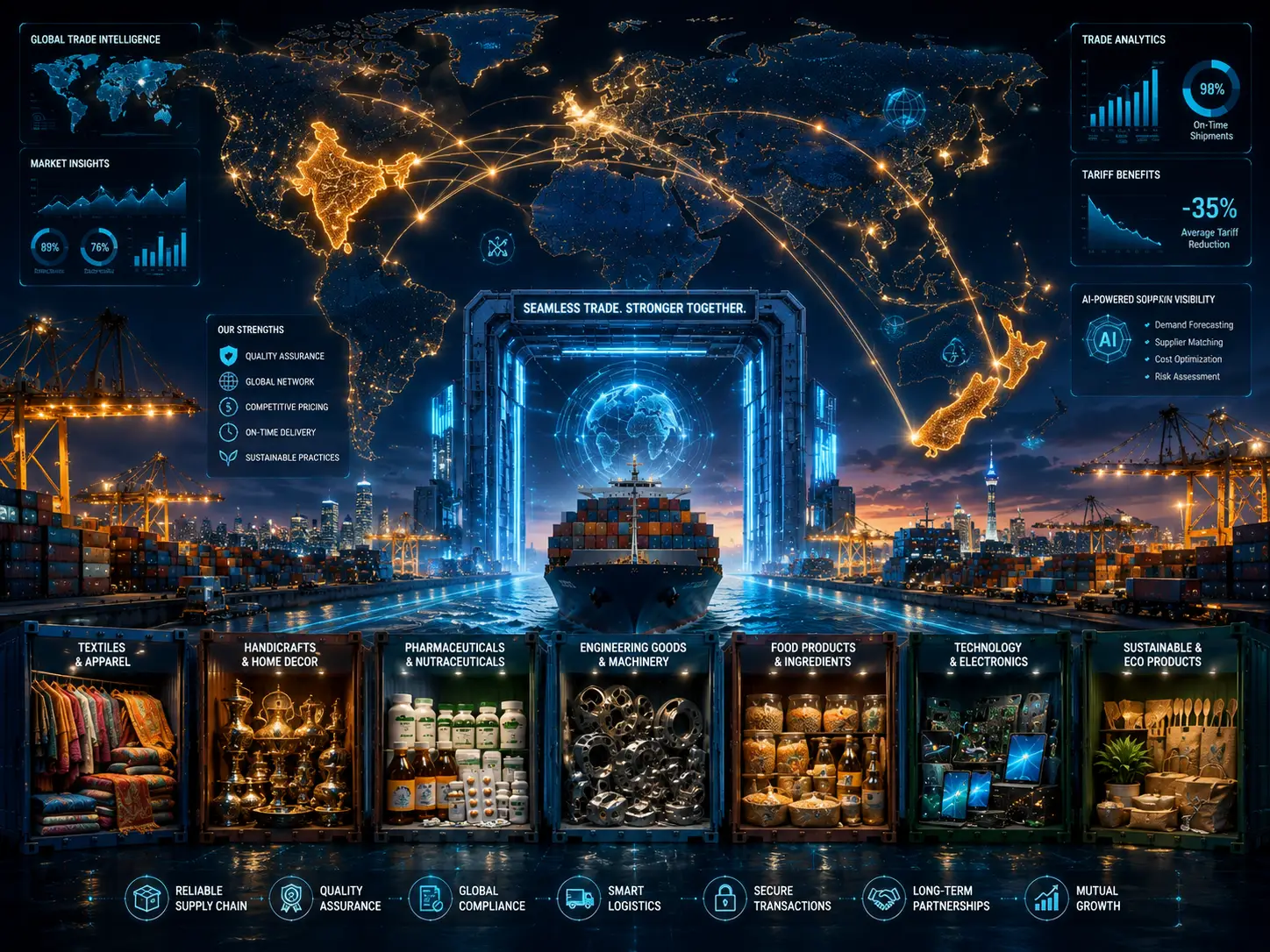
Sourcing from India Just Got Easier for New Zealand: What the India–NZ FTA Means for Importers
Meta description: The India–New Zealand Free Trade Agreement gives Kiwi importers tariff-free, faster, and more compliant access to Indian pharmaceuticals, organic foods, and manufacturing. Here’s what New Zealand buyers gain — and how to prepare.
On 27 April 2026, India and New Zealand signed one of the fastest free trade agreements in India’s history — concluded in just nine months. The headlines focused on Indian exporters, but the quieter story is this: for New Zealand importers and buyers, the agreement rewrites the math’s of sourcing from the world’s most cost-competitive manufacturing base.
If you import pharmaceuticals, food ingredients, textiles, engineering goods, or wellness products into New Zealand, here’s a clear, practical breakdown of what it means for you.
What the agreement actually does
Once the FTA enters into force, New Zealand-bound Indian goods become duty-free across 100% of export lines — roughly 8,284 tariff lines — with no phase-ins and no exclusions. That spans pharmaceuticals, processed and organic foods, textiles, leather, engineering goods, and chemicals.
New Zealand has always been a fairly open economy, but several categories of Indian goods still carried duties of up to around 10%. Those are now headed to zero — sharpening the price advantage on goods that were already competitively priced at the factory gate in India.
Why this matters specifically for Kiwi importers
It’s easy to read trade-deal coverage as a story about Indian sellers. But the practical winners on the ground are New Zealand buyers, who gain on four fronts at once:
| What you gain | What it means for your business |
|---|---|
| Lower landed cost | Tariff elimination on Indian goods directly cuts your cost of goods sold — margin you keep or use to win shelf space. |
| Faster border clearance | India commits to releasing goods within 48 hours, and within 24 hours for perishables and express consignments, via a single-window, paperless system. |
| Easier compliance | Electronic SPS (sanitary & phytosanitary) certification and Authorised Economic Operator recognition cut paperwork and delays. |
| Supply-chain resilience | A treaty-backed corridor to diversify away from over-dependence on any single source market. |
New Zealand is a high-value, quality-first import market rather than a high-volume one — and that plays directly to India’s strength in certified, compliant, consistent supply.
The sectors where New Zealand buyers gain most
- Pharmaceuticals & APIs — India is the world’s largest supplier of generic medicines. The FTA streamlines regulatory access by recognizing GMP and GCP inspection reports from comparable regulators, meaning faster approvals and lower compliance burden.
- Organic & processed foods — A Mutual Recognition Arrangement on organic standards supports clean-label imports such as basmati rice, while tariff removal opens up India’s wider processed-food basket.
- Health & wellness foods — For health-conscious New Zealand consumers, products like organic honey and foxnuts (makhana) become more viable to import and price competitively.
- Textiles, leather & engineering goods — Previously dutiable categories move to zero, a direct cost advantage for apparel, home furnishings, footwear, and industrial buyers.
An honest timeline note
The FTA has been signed but is not yet in force. It still requires domestic ratification — including review by New Zealand’s Parliament, expected to take around six months — before duties fall to zero. Both governments have signalled they want it operational within 2026.
The smart move for importers is to line up reliable Indian supply now, so you’re ready the day tariffs drop.
How to position yourself before it goes live
- Map your import basket against the duty-free lines so you know exactly where your savings will land.
- Qualify Indian suppliers early — certifications, capacity, and consistency matter more than the lowest quote in a quality-first market like New Zealand.
- Pre-build your compliance file (GMP, organic, SPS, certificates of origin) so first shipments clear without friction.
- Work with an India-side partner who can handle sourcing, vetting, documentation, and logistics end-to-end.
Source from India with a partner on the ground
Comexim Synergy LLP helps New Zealand importers source compliant, export-ready organic foods, basmati rice, foxnuts, honey, and pharmaceutical inputs from vetted Indian manufacturers — with documentation, quality checks, and logistics handled for you.
This article is for general information only and does not constitute legal, customs, or trade advice. FTA tariff treatment applies once the agreement enters into force and is subject to rules of origin and product-specific conditions. Verify current duty rates and eligibility for your specific goods before transacting.
Leave a Reply