
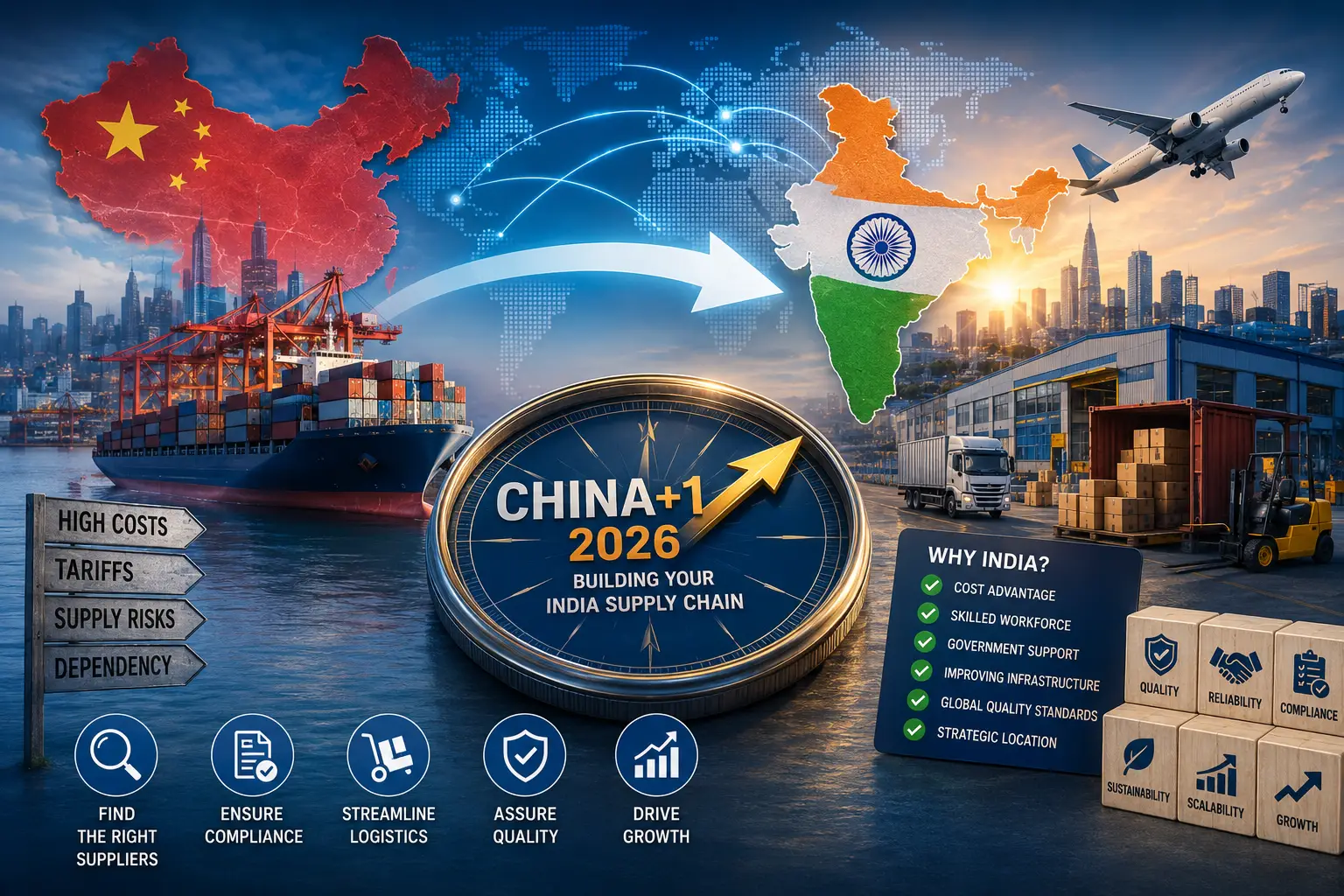
The Shift Is No Longer Theoretical
Five years ago, China+1 was a risk management concept discussed in boardrooms. In 2026, it is an operational reality being executed by the world’s largest companies.
The data is unambiguous:
- 73% of Fortune 500 companies are now actively building China+1 supply chains [ofisense.com]
- Apple’s iPhone exports from India crossed $23 billion in 2025 — an 85% jump from 2024 [imarcengineering.com]
- India’s share of global iPhone production reached approximately 25% in 2025 [imarcengineering.com]
- Gross FDI into India hit a record $94.53 billion in FY26 — up 17% year-on-year [indianexpress.com]
- India’s manufacturing output grew 8.1% in December 2025 — the strongest expansion in over two years [static.pib.gov.in]
The question for international buyers is no longer“Should we diversify from China?”
It is:“How do we build a reliable India supply chain — fast?”
Why India — and Why Now
The Cost Advantage Is Real
India offers a structural cost advantage that is difficult to replicate elsewhere: [smallworldindia.com]
| Category | India | China | India Savings |
|---|---|---|---|
| Average factory worker wage | $150–300/month | $500–800/month | 40–60% |
| Cotton T-shirt | $1.50–3.00 | $2.50–4.50 | 30–40% |
| Leather bag | $8–20 | $12–30 | 25–35% |
| Spices (per MT) | $1,200–4,000 | $2,000–6,000 | 30–50% |
| Chemicals (per MT) | $800–2,000 | $1,000–2,500 | 20–30% |
| Silver jewellery | $3–15 | $5–20 | 30–40% |
When US Section 301 tariffs are factored in, the total savings for US importers sourcing from India instead of China can reach 40–60% across key categories. [smallworldindia.com]
The Companies Have Already Moved
This is not a prediction. It is a documented industrial shift: [beaconfiling.com], [cncmachines.com], [investindia.gov.in]
- Apple: Targeting full transition of US-bound iPhone production to India by end of 2026 [fortuneindia.com]
- Foxconn: Invested $2.6 billion in a new facility near Bengaluru, targeting 50,000 workers by 2027 [beaconfiling.com]
- Samsung: US-bound smartphone exports from India surged 268% year-on-year [beaconfiling.com]
- HP Inc.: Plans 90% of North American products manufactured outside China by end of 2025 [cncmachines.com]
- Microsoft: Committed $3 billion to expand cloud and AI infrastructure in India [investindia.gov.in]
- Airbus: Plans to source $2 billion worth of components from India by 2030 [investindia.gov.in]
The Policy Infrastructure Is Ready
India has invested heavily in creating a manufacturing-friendly ecosystem: [arthneetiglobal.com], [realshepower.in]
- PLI Scheme: ₹1.97 lakh crore committed across 14 sectors — generating ₹20.41 lakh crore in production and 14.39 lakh jobs [arthneetiglobal.com]
- Dedicated Freight Corridors: 2,843 km of freight-only rail now operational — cutting transit times by 50% [kpmg.com]
- 7 new high-speed rail corridors announced in Budget 2026, including Hyderabad-Bengaluru and Hyderabad-Chennai [infra.econ…atimes.com]
- Record ₹12.2 lakh crore public capital expenditure on infrastructure in Budget 2026 [logisticsinsider.in]
- 9 FTAs going live covering 38 developed economies — including EU, UK, Oman, UAE, and Australia
The 90-Day Playbook: How to Build Your India Supply Chain
Here is a practical, step-by-step framework for international buyers ready to act:
Days 1–30: Discovery and Qualification
Objective: Identify the right suppliers and validate capability
Actions:
- Define product specifications, volumes, and quality standards
- Identify 10–15 potential Indian manufacturers in your category
- Request samples and capability documentation
- Verify factory certifications (ISO, BIS, FSSAI, APEDA — as relevant)
- Conduct virtual or on-ground factory assessments
Key insight: India has 63 million+ registered MSMEs. The challenge is not finding suppliers — it is finding the right ones. [imarcengineering.com]
Days 30–60: Structuring and Compliance
Objective: Build a compliant, executable sourcing structure
Actions:
- Finalise supplier selection (2–3 qualified suppliers per product)
- Execute NDAs and vendor agreements
- Align on Incoterms (FOB, CIF, or DDP)
- Verify export documentation requirements (IEC, GST, COO, shipping docs)
- Confirm destination-country compliance (CE marking, FDA, REACH — as applicable)
- Agree on quality inspection protocols (pre-shipment)
Key insight: Documentation errors are the#1 cause of shipment delays for new India sourcing relationships. Getting compliance right from Day 1 prevents costly problems later.
Days 60–90: Execution and Delivery
Objective: Complete first order and establish repeatable process
Actions:
- Place first purchase order
- Conduct pre-shipment quality inspection
- Coordinate logistics (freight booking, customs clearance, delivery)
- Track shipment through to destination clearance
- Conduct post-delivery review (quality, timeline, documentation accuracy)
- Establish reorder framework and communication cadence
Key insight: The first order is a proof of concept. Get it right, and you have a scalable, repeatable India supply chain.
Where India Wins — Sector by Sector
Not every product category is equally competitive. Here is where India offers the strongest sourcing advantage in 2026:
Immediate Opportunity (India clearly competitive)
- Textiles and apparel — 30–40% cheaper than China [smallworldindia.com]
- Leather and footwear — 25–35% cheaper [smallworldindia.com]
- Spices, food, and agri products — 30–50% cheaper [smallworldindia.com]
- Jewellery and handicrafts — 30–50% cheaper [smallworldindia.com]
- Pharmaceuticals and APIs — globally competitive, WHO-certified base
- Chemicals (specialty and commodity) — 20–30% cheaper [smallworldindia.com]
Growing Opportunity (India rapidly scaling)
- Electronics and smartphones — Apple, Samsung already at scale [beaconfiling.com]
- Auto components — PLI-driven expansion [arthneetiglobal.com]
- Engineering goods — $16 billion+ already exported to EU
China Still Leads (for now)
- Ultra-high-volume standardised products
- Advanced semiconductor manufacturing
- Complex precision machinery
The Hidden Risks — and How to Mitigate Them
Every experienced sourcing professional knows that cost advantage means nothing if execution fails. Here are the real risks buyers face when sourcing from India:
1. Sample vs Bulk Quality Gap
Indian sample quality is often excellent. Bulk production can vary. Mitigation: Mandate pre-shipment inspection on every order until the supplier proves consistency.
2. Communication Drops After Payment
Responsive before the PO, silent after. Mitigation: Establish structured communication cadence — weekly status updates, milestone reporting.
3. Logistics Unpredictability
India’s port infrastructure is improving but not yet at China’s level. Mitigation: Work with experienced freight coordinators who understand Indian port dynamics.
4. Compliance and Documentation Errors
GST alignment, COO certificates, HS code classification — mistakes happen. Mitigation: Partner with an export management company that handles documentation end-to-end.
How Comexim Supports Your China+1 Strategy
At Comexim Synergy LLP, we exist precisely for this moment.
We are a DPIIT-recognised, AI-powered merchant export company based in Hyderabad, India — built specifically to help international buyers source from India without operational risk.
What we do:
- Verified Supplier Network — Pre-vetted manufacturers across textiles, food, chemicals, jewellery, pharma, engineering, and more
- End-to-End Compliance — Export documentation, GST alignment, Rules of Origin, destination-country regulatory requirements
- Logistics Coordination — Freight planning, customs clearance, delivery timeline management
- AI-Driven Sourcing Intelligence — Data-powered supplier matching, demand forecasting, and trade analytics through our proprietary AI Trade Connect+ platform
- Quality Assurance — Pre-shipment inspection, factory audits, and ongoing supplier monitoring
We don’t just introduce you to suppliers. We build, manage, and protect your India sourcing pipeline.
Conclusion: The Window Is Open — But Not Forever
The China+1 shift is accelerating. Every major multinational — from Apple to Airbus — is building India operations at unprecedented speed.
For mid-market importers, the opportunity is even greater. While large corporations negotiate directly with Indian manufacturers, smaller buyers need a structured trade partner to access the same supplier base, ensure compliance, and manage execution.
That is exactly what Comexim delivers.
The buyers who build their India supply chain now will:
- Lock the best suppliers before capacity fills
- Negotiate stronger pricing before demand drives costs up
- Build competitive advantages that last for years
The ones who wait will find themselves competing for whatever capacity remains.
Ready to Build Your India Supply Chain?
👉 Connect with Comexim Synergy LLP 👉 Get a curated supplier shortlist 👉 Let us handle compliance, quality, and logistics — so you can focus on growing your business.
🌐 Visit: www.comexim.in 📧 Email: export@comexim.in
Leave a Reply