
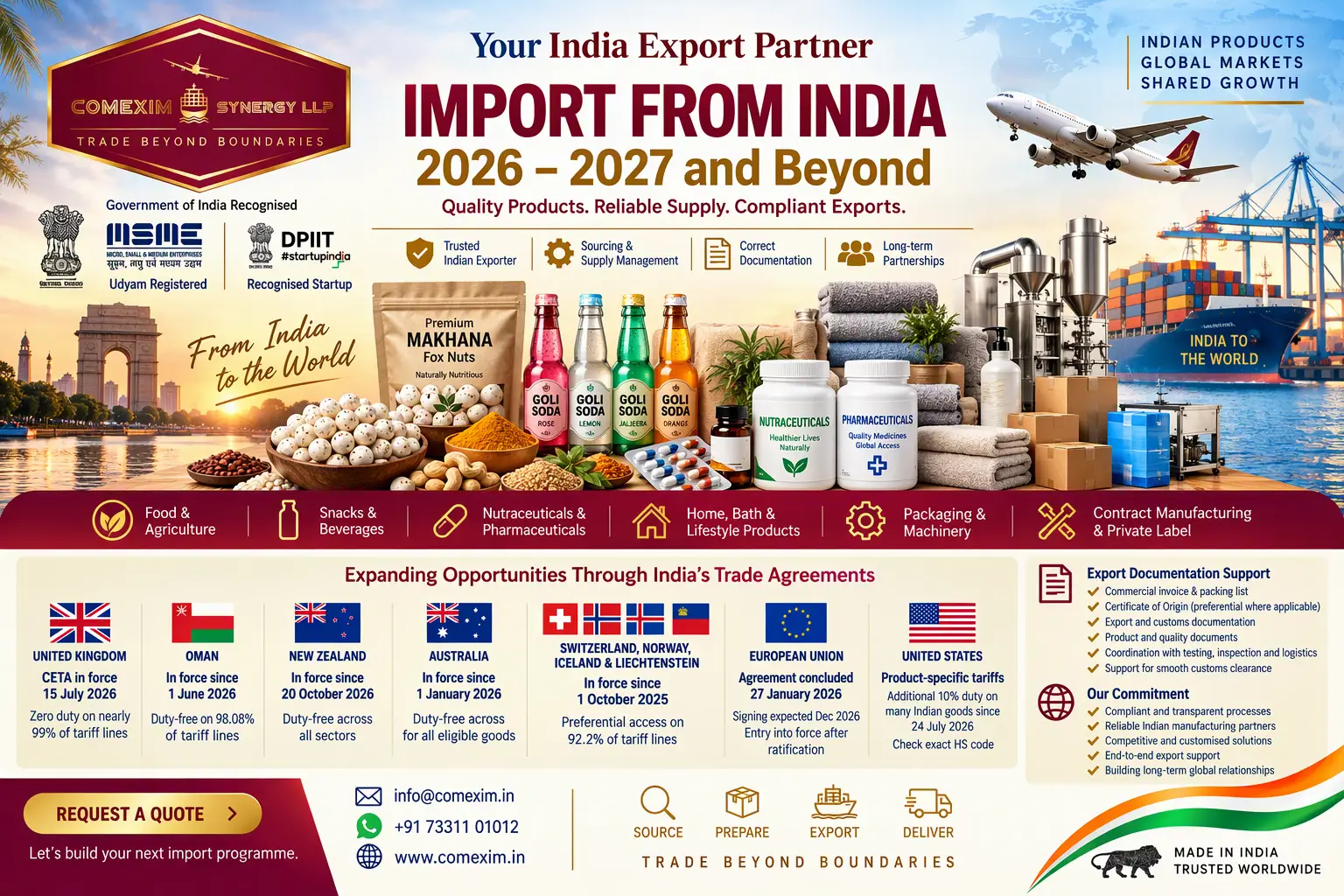
Import from India in 2026–2027 and Beyond: Products, Trade Agreements and How to Order
As 2026 draws to a close, international buyers, importers and distributors are already preparing their purchasing programmes for 2027.
India offers access to a broad manufacturing ecosystem covering food and agriculture, nutraceuticals, pharmaceuticals, textiles, home products, packaging, machinery, engineering goods, chemicals, private-label products and contract manufacturing.
However, successfully importing from India requires more than finding a supplier. Buyers also need the right product specification, correct documents, reliable commercial terms, suitable packaging and disciplined coordination from quotation to shipment.
Comexim Synergy LLP is an Indian merchant exporter and importer based in Hyderabad, India.
We work with Indian manufacturers and suppliers, develop commercial offers, coordinate export documentation and execute suitable shipments for international buyers.
Where the product, compliance pathway and transaction structure permit, Comexim purchases from the Indian manufacturer and exports to the overseas buyer in Comexim’s name.
Our objective is to help international buyers purchase suitable Indian products through one accountable Indian export company.
Why Import from India in 2027?
International procurement is changing. Buyers are looking beyond factory price and evaluating supply reliability, product quality, compliance, packaging, lead times, payment security and documentation.
India gives buyers the opportunity to diversify existing supply chains, develop private-label products, access specialist manufacturing capabilities and purchase established Indian products for international distribution.
Official Indian trade data also allows buyers to assess demand, export trends and competing markets by product and country through the Government of India’s Trade Intelligence and Analytics Portal. [trade-anal…rce.gov.in]
India’s recent trade agreements have further improved market access in several important destinations.
United Kingdom
The India-United Kingdom Comprehensive Economic and Trade Agreement entered into force on 15 July 2026. The United Kingdom government states that 99% of Indian goods entering the United Kingdom are either duty-free or benefit from tariff reductions. [gov.uk], [business.gov.uk]
To claim preferential duty, the product must satisfy the agreement’s applicable rules of origin and carry acceptable origin evidence. The United Kingdom tariff service recognises an origin declaration, certificate of origin or importer’s knowledge for eligible claims. [trade-tari…ice.gov.uk]
Buyers can review the official details through the United Kingdom-India Trade Deal guidance. [gov.uk]
Oman
The India-Oman Comprehensive Economic Partnership Agreement provides zero-duty access across 98.08% of Oman’s tariff lines, covering approximately 99.38% of India’s exports by value. The agreement identifies opportunities in textiles, engineering products, plastics, agriculture, pharmaceuticals, medical devices and other labour-intensive sectors. [commerce.gov.in]
The agreement also contains detailed rules covering classification, origin, proof of origin, certificates of origin, direct consignment and verification. [commerce.gov.in]
Buyers can review the official India-Oman agreement announcement. [commerce.gov.in]
New Zealand
The New Zealand-India Free Trade Agreement entered into force on 20 October 2026. The agreement creates new opportunities for two-way trade, supports customs simplification and provides product-specific tariff treatment under the published schedules. [mfat.govt.nz], [mfat.govt.nz]
Importers should check the relevant tariff line, rules of origin and New Zealand’s biosecurity requirements before ordering food, plant, agricultural or natural products.
Official information is available on the New Zealand-India Free Trade Agreement portal. [mfat.govt.nz]
Australia
The Australia-India Economic Cooperation and Trade Agreement entered into force on 29 December 2022. Australia’s Department of Foreign Affairs and Trade confirms that 100% of imports from India are now tariff-free, subject to origin and documentation requirements. [dfat.gov.au], [dfat.gov.au]
The official guidance explains that importers must identify the correct tariff classification, verify origin eligibility and obtain the required certificate of origin. [dfat.gov.au], [dfat.gov.au]
Buyers can review the Australia-India agreement and implementation guidance. [dfat.gov.au]
European Union
India and the European Union concluded free-trade agreement negotiations on 27 January 2026. However, the European Commission states that the published text remains subject to legal revision and will become binding only after signature and completion of the required internal legal procedures. [policy.tra….europa.eu], [policy.tra….europa.eu]
European Union buyers can begin assessing products, suppliers and origin requirements, but future preferential tariffs should not be used in landed-cost calculations until the agreement formally enters into force.
The current legal position and published text are available on the European Commission’s European Union-India agreement page. [policy.tra….europa.eu]
United States
United States tariff treatment remains product-specific.
The Office of the United States Trade Representative imposed additional Section 301 duties of 10% or 12.5% on covered products from 60 economies, subject to specified product exemptions. The additional duties became applicable from 24 July 2026. [ustr.gov], [ustr.gov], [ustr.gov]
A United States buyer should calculate the complete duty position using the exact Harmonized Tariff Schedule classification:
Buyers can review the official United States Trade Representative Section 301 action. [ustr.gov]
In every market, the actual tariff benefit depends on the product classification, origin rules and supporting documents.
Products You Can Import Through Comexim
Comexim works across multiple product and manufacturing sectors. Every enquiry is assessed according to the required specification, quantity, destination, supplier capability and commercial feasibility.
Food, Agriculture, Snacks and Beverages
Potential categories include makhana or fox nuts, rice, pulses, grains, spices, turmeric, moringa powder, cashew kernels, food ingredients and selected agricultural products.
Packaged-product opportunities may include roasted makhana, Indian savoury snacks, banana chips, traditional beverages and goli soda.
For private-label enquiries, Comexim coordinates the proposed recipe, flavour, pack size, label artwork, minimum production quantity and required export documents.
Nutraceuticals and Pharmaceuticals
India has significant manufacturing capabilities in nutraceuticals, pharmaceuticals and life sciences.
Depending on the destination market and regulatory pathway, Comexim can assess capsules, tablets, effervescent tablets, sachets, powders, vitamins, minerals, electrolyte products, herbal formulations, pharmaceutical formulations and active pharmaceutical ingredients.
Before preparing a commercial offer, we review the available manufacturer and product documentation. This may include facility credentials, Good Manufacturing Practice documents, product specifications, Certificates of Analysis, laboratory reports, packaging information and destination-market requirements.
Private-label and contract-manufacturing programmes may also be assessed for buyers with an existing formula, product specification or brand concept.
Home, Lifestyle, Packaging and Machinery
Potential categories include bed linen, terry towels, home textiles, bathroom accessories, furniture, handcrafted products, packaging materials, corrugated boxes and polyethylene terephthalate bottles.
Comexim can also assess requirements for food-processing machinery, packaging machinery, pharmaceutical machinery, induction cap sealers, testing equipment, solid-liquid separators and selected industrial components.
Machinery buyers should provide the required output, electrical standard, automation level, material of construction, installation requirements and destination-country conformity standards.
Why Work With Comexim?
Comexim combines merchant export execution with India-side manufacturer coordination.
Comexim Synergy LLP is:
- Registered under Udyam as a micro, small and medium enterprise
- Recognised as a startup by the Department for Promotion of Industry and Internal Trade
- Registered with the Agricultural and Processed Food Products Export Development Authority for covered product categories
- Operating as an Indian merchant exporter and importer
Our role may include product assessment, manufacturer coordination, quotations, samples, packaging, export documentation, freight and shipment follow-up.
One of our main priorities is correct documentation.
Depending on the product and market, a shipment may require a commercial invoice, packing list, shipping bill, bill of lading, certificate of origin, insurance certificate, Certificate of Analysis, laboratory report, health certificate, phytosanitary certificate or other product-specific documents.
The document requirements are identified during the product and quotation stage rather than after the goods are ready for shipment.
How to Import from India Through Comexim
The process begins when the buyer shares the product specification, quantity, packaging, destination country, port and required delivery date.
Comexim then evaluates suitable Indian manufacturing capability, likely tariff classification, product documentation, packaging and shipment feasibility.
Where a commercially suitable option is available, the buyer receives a quotation covering the product, specification, minimum order quantity, price, delivery term, lead time, payment terms and documentation scope.
Samples may be arranged where practical. After product and commercial approval, Comexim coordinates the agreed production, packaging, export documentation, freight and shipment process.
For initial transactions, payment is generally structured through advance payment or an acceptable letter of credit at sight. Final terms depend on the product, country, order value and transaction risk.
Frequently Asked Questions
What is the minimum order quantity?
The minimum order quantity depends on the product, manufacturer and packaging. It is confirmed in each quotation.
Can I request samples?
Samples may be arranged for suitable products. Product, customisation and courier costs are confirmed before dispatch.
Does Comexim support private label and contract manufacturing?
Yes, subject to manufacturer capability, regulatory requirements, packaging and minimum production quantities.
Which delivery terms can Comexim quote?
Depending on the transaction, Comexim may quote Ex Works, Free on Board, Cost and Freight, Cost, Insurance and Freight, or Delivered at Place.
Can Comexim export to my country?
Comexim assesses international enquiries based on the product, destination regulations, banking feasibility, logistics and supplier availability.
Plan Your 2027 India Import Programme
Buyers planning orders for 2027 should begin product assessment, packaging development, documentation review and supplier coordination before the intended shipment date.
To request a quotation, share:
- Product and specification
- Quantity and packaging
- Destination country and port
- Required testing or documents
- Target delivery date
- Preferred delivery term
Contact Comexim Synergy LLP
Indian Merchant Exporter, Importer and International Market-Entry Company
Email: info@comexim.in
WhatsApp: +91 73311 01012
Website: comexim.in
Quotation form: Request a quotation
Trade Beyond Boundaries, Powered by Intelligence.
Sources Checked on 9 November 2026
- United Kingdom-India trade agreement [gov.uk]
- United Kingdom tariff and proof-of-origin guidance [trade-tari…ice.gov.uk]
- India-Oman agreement announcement [commerce.gov.in]
- New Zealand-India Free Trade Agreement [mfat.govt.nz]
- Australia-India Economic Cooperation and Trade Agreement [dfat.gov.au]
- European Union-India agreement text [policy.tra….europa.eu]
- United States Section 301 action [ustr.gov]
- Government of India Trade Intelligence and Analytics Portal [trade-anal…rce.gov.in]
Leave a Reply